Hospitality & Payments (Choice Hotels)
PCI Tokenization Proxy & Okta Auth Migration
Migrated legacy PCI tokenization systems into a highly available Spring Boot microservice using the proxy pattern and Okta JWT authentication.
Problem
Card data at a hotel chain passes through many systems, and every system that touched it fell inside PCI compliance scope. Audits were costly and every payment-adjacent change was slow.
The legacy tokenization provider was also expensive and came with many restrictions, and access to it relied on a legacy authentication mechanism, so it was hard to say, and to prove, who could tokenize a card.
The goal was one small, highly available place where only authenticated clients can exchange a card for a token, without interrupting bookings.
System Architecture
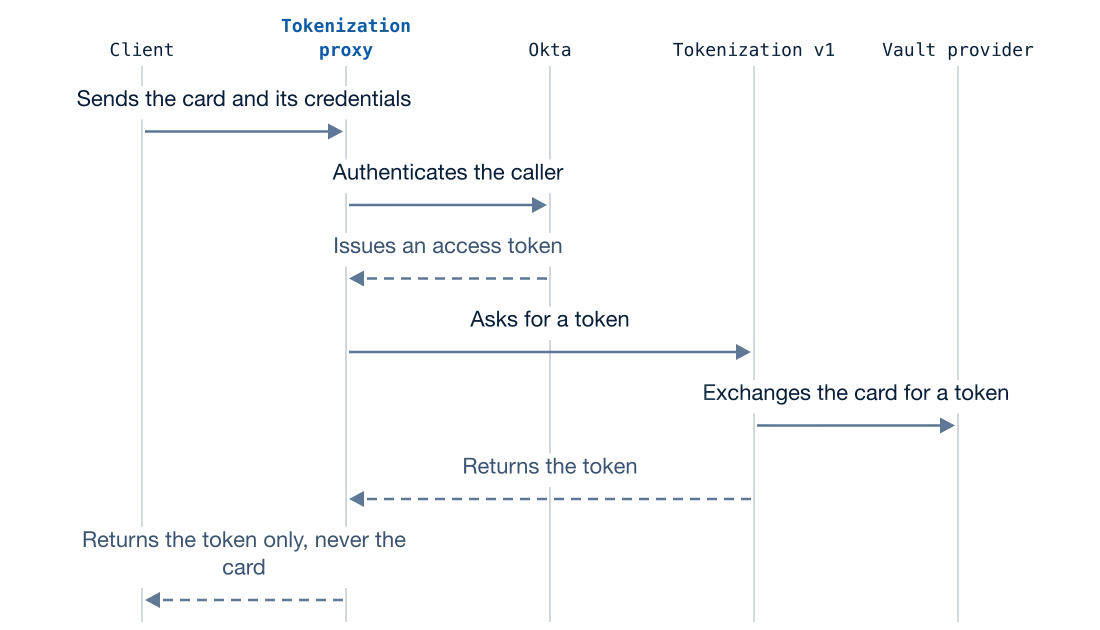
A Spring Boot microservice acts as a proxy in front of the existing tokenization service. Every call passes through it, so it controls the whole flow: who may call, what is sent on and what comes back. The flow above is a simplified illustration of that shape.
- Authenticate first. Okta-issued JWTs mean only authenticated clients can tokenize a card. Access tokens are cached and checked locally, so Okta is not in the path of every request.
- Validate, then forward. The proxy checks and maps each request before it reaches the tokenization service, and returns only the token, never the card.
- Gradual cut-over. Consumers moved over one at a time instead of in one big switch.
Trade-offs
- One extra hop on payment-adjacent calls, in exchange for a single, small, auditable PCI boundary.
- A critical shared dependency, so it had to be built for high availability from day one.
- Cached tokens trade freshness for speed. Checking tokens locally keeps Okta off the hot path, but a revoked token keeps working until it expires.
- Standard identity over custom auth: an external dependency, but no bespoke credential handling.
Measurable Impact
- PCI compliance scope was isolated to the tokenization service and its proxy boundary.
- Only authenticated clients can tokenize a card, and access is explicit and auditable per client.
- High availability was maintained across thousands of US hotels throughout the migration.