Banking & FinTech (Bancolombia)
Tier-1 Digital Banking Modules & Code Quality Transformation
Engineered core microservices for mobile wallet, SmartWatch QR 2.0 payments, and dynamic feature flags serving millions of banking users.
Problem
Bancolombia’s mobile banking app serves millions of users, so new features ship into one of the highest-traffic, most regulated environments in the region. The team needed new modules (a mobile wallet, SmartWatch QR 2.0 payments and the Life Coach module) without risky releases. Accumulated code smells and vulnerabilities across the mobile app and the Sucursal Virtual de Personas (SVP) platform were also slowing delivery and raising risk.
System Architecture
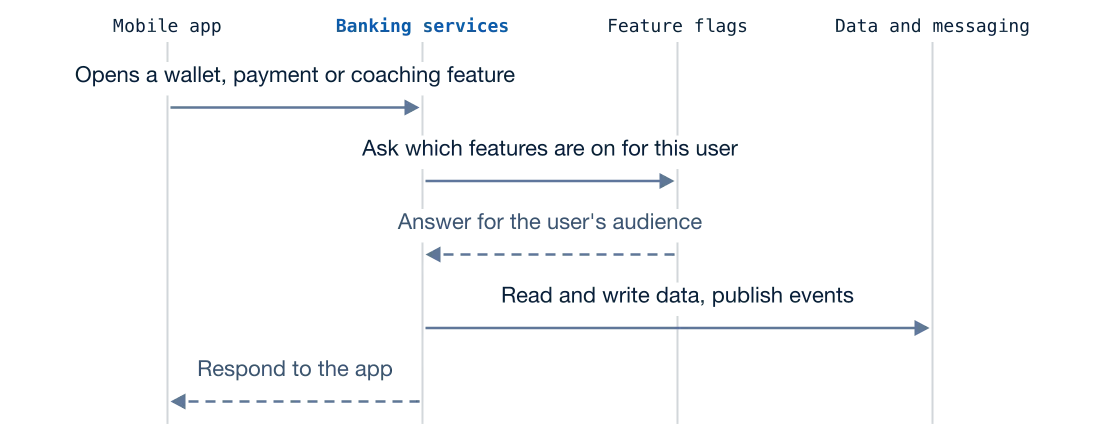
The flow above is a simplified illustration of how a request from the app moves through the services, with the build-time quality gates described below.
- Spring Boot microservices (Java 8) for the Wallet, SmartWatch QR 2.0 payments and Life Coach modules, running on AWS EKS.
- A dynamic feature-flag system lets features be switched on per audience at runtime. This enabled zero-downtime deployments and real-time personalization.
- Supporting data and messaging: Oracle DB, ActiveMQ and Apache Flink.
- Quality gates in CI with SonarQube and Jenkins, so new code could not reintroduce the issues being removed.
Trade-offs
- Runtime flags over release branches. Shipping dark and switching on later decouples deploys from launches, at the cost of flag lifecycle management: stale flags have to be removed.
- Remediation alongside feature work. Cleaning up code quality while still shipping features is slower in the short term, but it compounds. Gates in CI keep the gains from eroding.
- Kubernetes (EKS) over simpler hosting gives the bank consistent scaling and deployment across many services, in exchange for more platform complexity.
Measurable Impact
- SonarQube code smells and vulnerabilities reduced by more than 95% across critical banking platforms (the SVP and mobile app projects).
- Zero-downtime deployments enabled by the feature-flag system, for an app used by millions of banking users.